Plant Health Recovery
Bringing a Lightning-Struck Live Oak Back
South Louisiana
Most people assume a lightning strike means the tree is gone. Not always.
- Tree species
- Southern live oak
- Project type
- Plant health recovery
- Year
- 2026
- Client
- Private homeowner
 Primary arborist
- Ricky Folse
The Challenge
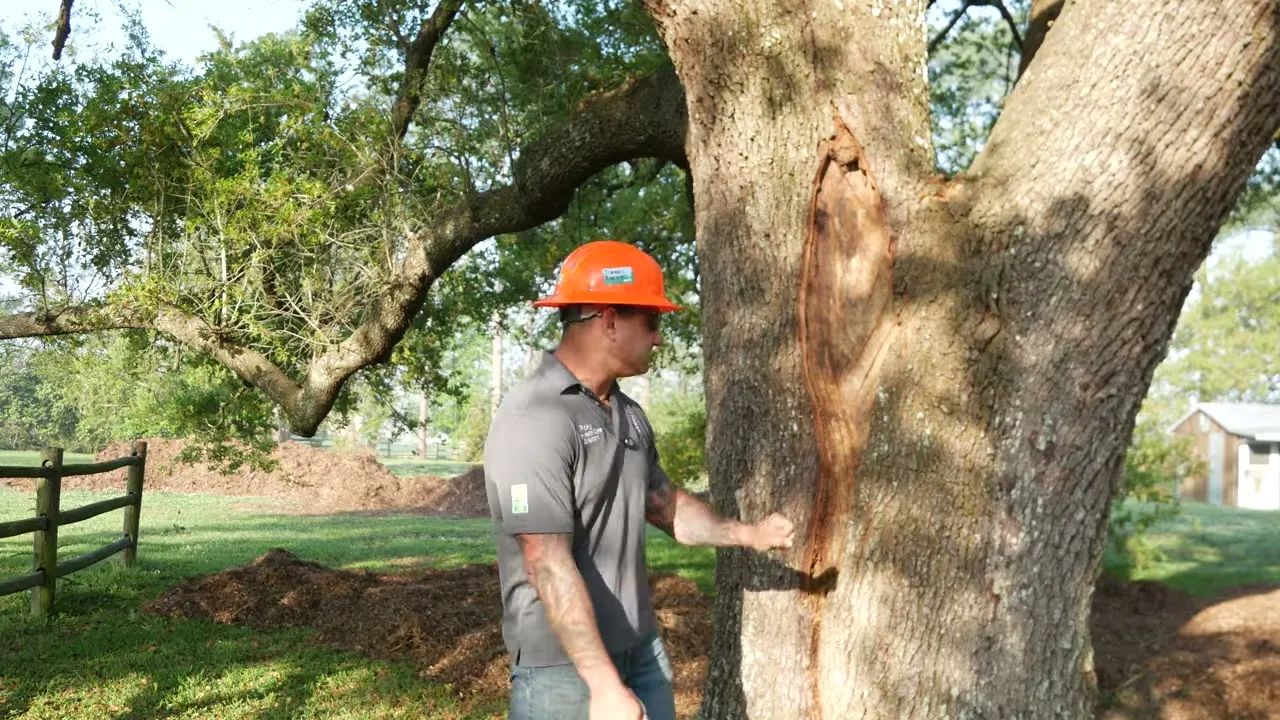
A live oak the owners loved had bark splitting and falling away in three or four places on the trunk. Tiny holes and fine, sawdust-like frass showed that wood-boring insects were already at work.
The Assessment
Ricky diagnosed the likely primary cause as lightning. The heat had killed the cambium beneath the bark, causing it to separate from the wood. The borers were a secondary problem: decomposers that arrive once a tree is stressed. Sap flowing where tissue was still alive showed the tree was actively defending itself.
The Solution
Dead, separated bark was cut and traced back to live tissue. Two hundred gallons of the “tree gumbo” soil treatment went into the root zone: ecto-mycorrhizae suited to live oaks, humates and a triple dose of biochar. Fertilizer and nitrogen were deliberately held back. A nearby tree with a smaller wound was treated as well, and six inches of organic arborist chips were laid down.
Why this approach
Once borers are past the cambium, insecticides can’t reach them effectively. The better strategy is to rebuild the tree’s vigor, which is its immune system, so it can wall off the damage (CODIT). Holding back nitrogen keeps the tree’s energy on defense rather than new growth.
The Result
Wound edges prepared for closure and the tree’s defenses supported, with follow-up applications at 30 and 60 days and ongoing monitoring of its recovery.
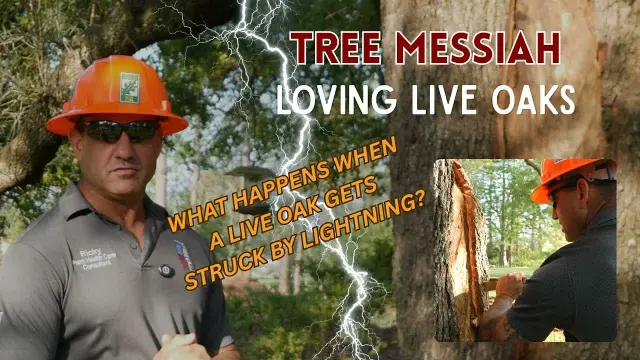 VideoWatch the diagnosis (7 min)
Documented in Loving Live Oaks, Episode 3 (March 2026).
The arboricultural science
Techniques Used on This Project.
Only the methods actually used on this project are listed.
- Plant health careDiagnosing and treating the causes of decline, not just the symptoms.
- Bark tracingRemoving dead, separated bark back to live tissue so the wound can begin to close.
- Tree / soil injectionsDelivering treatments, biology or nutrients where the tree can use them.
- Soil biology restorationEcto-mycorrhizae, humates and charged biochar to rebuild living soil.
- CODITCompartmentalization of Decay in Trees: supporting the tree’s own ability to wall off damage.
- Root-zone protection with arborist chipsWhole-tree wood chips insulate roots, hold moisture and feed soil life.
- Ongoing monitoringScheduled re-inspections to track the tree’s response and adjust treatment.
Start with an arborist
Have a Project Where Experience Matters?
-
Residential tree work
Pruning, removal and stump grinding, planned and done by the arborist you meet.
Join the waitlist -
Advanced arboriculture
Historic trees, risk assessments, legal or insurance questions, construction planning and commercial work.
Schedule an arborist consultation -
Emergencies
Trees on homes, cars, roads or lines. 24/7.
Call now -
Veterans
Structure, camaraderie, purpose and a path to leadership.
Continue your mission with us