
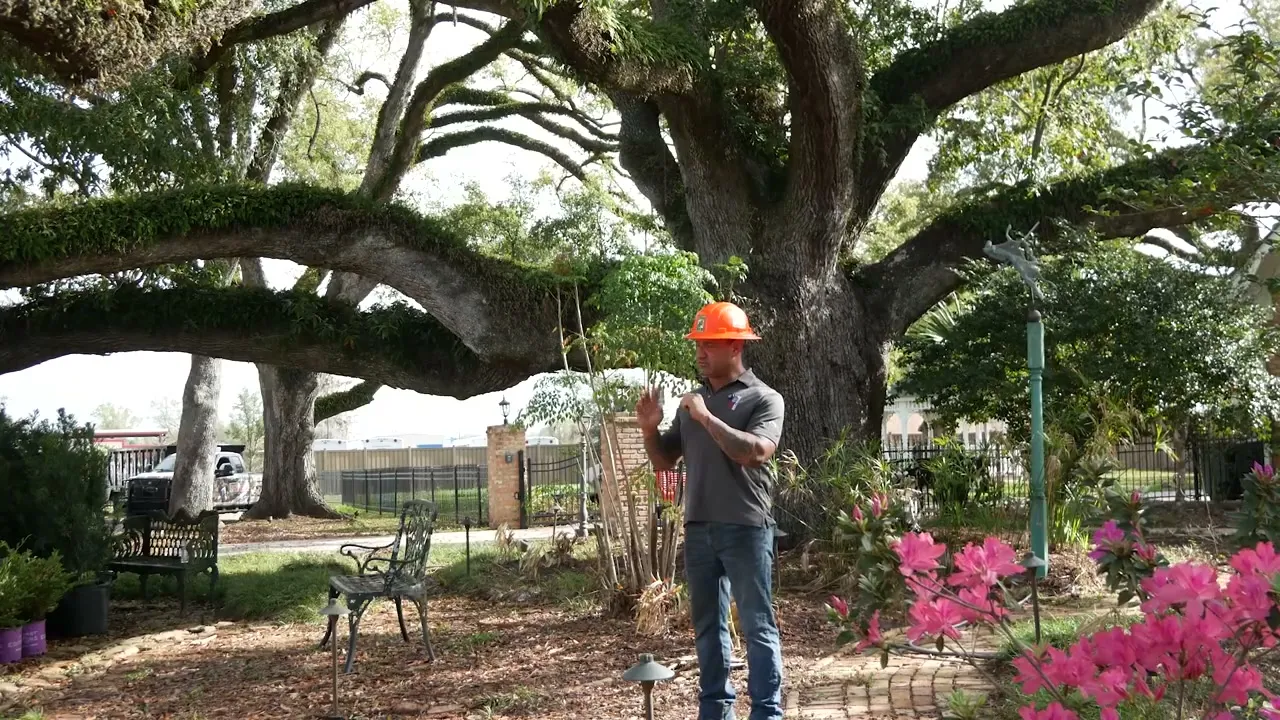
Few trees carry as much history as a South Louisiana live oak. When one starts to decline, drops a limb or takes a lightning strike, owners are often told it has to come down. Sometimes that’s true. Often it isn’t. Here is how a professional arborist approaches the question.
Start with the cause, not the symptom
Dieback, thinning leaves, borer holes and fungus are signs of a problem, not the problem itself. Insects and decay fungi are usually secondary: they move in once a tree is already stressed. The real question is what caused the stress. Common answers include compacted soil, roots cut during construction, soil or mulch piled against the trunk, girdling roots, drought or flooding, lightning, and poor pruning.
If the primary cause can be found and corrected, a tree has a much better chance of recovering.
Four things that decide whether a live oak can be kept
- Structure. Are the main trunk and scaffold limbs sound, or can weak points be reduced, cabled or braced?
- Roots. Is enough healthy root system left to anchor and feed the tree? Air-spade excavation lets an arborist see the root flare without damaging it.
- Decay. How much sound wood remains in the trunk and major roots? Advanced assessment can answer this when it matters.
- Targets. What would the tree hit if it failed, and can that risk be lowered to an acceptable level?
What preservation usually looks like
For many mature oaks, preservation is less about dramatic intervention and more about restoring the conditions the tree evolved in. That can mean clearing buried root flares, correcting girdling roots, relieving compaction, rebuilding soil biology, replacing turf with whole-tree arborist chips, reducing overextended limbs, and monitoring over time.
A lightning-struck oak, for example, may lose sections of bark where the cambium was killed. If the damage is limited and the tree’s vigor can be rebuilt, it can compartmentalize the wound and keep growing.
When removal is the right answer
Removal becomes the responsible choice when structural failure is likely and can’t be corrected, when decay or root loss is too extensive, or when the risk to people or property can’t be brought to an acceptable level. A good arborist will tell you that plainly.
Get an assessment before you decide
A live oak that took two centuries to grow deserves more than a quick look from someone who is paid by the cut. Ask for an assessment from a qualified arborist before making an irreversible decision.